
When the warm summer weather settles into Nashua, having a reliable air conditioning system becomes essential to keep your family comfortable. If you’re considering upgrading your existing system, you have a couple of different options, the most common being ductless mini-split systems and conventional central air conditioners. Below, we’ll take a look at what these systems are so that you can make a better-informed decision about which one is right for your home.
What Is Central AC?
One of the most common types of home air conditioning systems is the central air conditioner. These systems use a series of air ducts to distribute cold air throughout the various rooms of your home. They can work right alongside a furnace, making them an easy option for homes with existing ductwork.
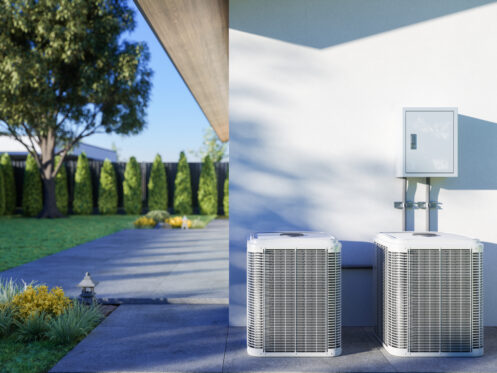
Central air conditioners are comprised of a few different components. They have an indoor air handler unit. This is responsible for dispersing cold air throughout your home. Then there’s an outdoor condenser unit that’s responsible for dispersing heat outside your home. They also have a thermostat that’s responsible for regulating temperature according to your needs.
All air conditioning systems work in relatively the same manner. They start by pulling in air from inside your home and passing it over an evaporator coil. Inside this evaporator coil is a low-pressure refrigerant. Because heat naturally wants to move to whatever low-pressure substance is near, it will move from the air into the refrigerant inside the coil.
The compressor pump inside your outdoor condenser unit is responsible for circulating refrigerant between the inside and outside of your home. Once that hot refrigerant gets pumped to the outdoor unit, it passes through a condenser coil. Because the air outside is at a lower pressure than the refrigerant, heat naturally moves to the air outside. This process is accelerated thanks to a blower fan inside the outdoor unit that forces outside air over the condenser coil.
The Benefits of Central ACs
There are many different reasons that central air conditioners are a popular choice for a lot of homeowners. Those who already have existing ductwork for a furnace setup can easily purchase a central air conditioner at a relatively affordable cost. They provide consistent cooling throughout your entire home thanks to the ducting that helps to maintain a stable temperature in multiple rooms simultaneously.
Another major advantage of central AC units is that they’re very clean-looking. All that you see throughout your home are your air vents. The only part where you actually see your air conditioner is outside at the condenser unit and near your furnace at the indoor air handler unit. Installing a new central air conditioner in your home can be a great way to not only enhance your comfort but also the resale value of your property.
The Drawbacks of Central AC Systems
While central air conditioners have a lot of advantages for homeowners, they do come with their fair share of disadvantages, too. One of the biggest ones is air losses. It’s estimated by the EPA that homeowners with aging ductwork lose between 20% and 30% of the cold air that their air conditioner produces. This is lost through ductwork damage that causes leaks or through poorly insulated ductwork. When it comes to your summertime cooling bills, that can be a significant amount of money that you’re losing.
If your home isn’t already set up with existing ductwork for a forced-air heating system, it can be very expensive to install ductwork after the fact. This is because you have to rip out drywall and flooring to install the air ducts. Then, you’ll need to pay a contractor to repair all the pieces that were ripped out. Another potential drawback of a central air conditioner is that there’s no way to section off cooling different rooms of your home without a zoned damper setup.
What Is a Ductless Mini-Split System?
Ductless systems are simply an air conditioning system that doesn’t use traditional air ducts. You may hear them referred to as mini-split systems. Instead of distributing air throughout ductwork, these systems use individual air handler units. Each unit has its own thermostat that tells the unit when to turn on and off. When it turns on, it pulls air into the air handler unit. Then, the air is cooled and redispersed within the same unit.
This mini-split setup includes a few different components. These include the outdoor condenser unit, refrigerant lines, and indoor air handler units. Indoor air handler units are positioned in various rooms throughout your home. They come in a few different forms, including wall-mounted, ceiling-mounted, and floor-mounted.
The Advantages of Going Ductless
Just like central air conditioners, ductless mini-split systems also have a lot of great advantages for homeowners. One of the biggest advantages is that they’re great for retrofitting homes that don’t have existing ducting. It’s typically more cost-effective to simply install ductless units throughout your home than to rip out your drywall to install traditional ducting. In fact, ductless systems are a popular choice for home additions, finished basements, attics, garages, and even sunrooms.
Because each indoor air handler unit has its own thermostat, you can set it independently from all the other units in your home. This means that you can keep your bedroom slightly cooler than your living room. This can allow you to shut off units in rooms that you don’t use so that you can save money. With a ductless system, you don’t have to worry about that 20 to 30% energy loss because there’s no ducting.
Another major advantage of ductless systems is that they’re highly energy efficient. Modern mini-splits use variable-speed inverter technology that allows each unit to adjust its cooling output continuously. With the traditional central air conditioner, it either turns on or off. With a variable-speed mini-split, it can run at say 20, 40, or even 60% capacity.
This consumes much less energy while keeping your home more comfortable. Because ductless systems are so energy efficient, the federal government is providing homeowners with rebates when they invest in them. All eligible systems can allow you to claim up to $3,200 per year in the form of a tax credit on your federal tax returns. This is under the Inflation Reduction Act of 2022. You may also find that many local utility companies will provide you with a one-time rebate on your energy bill when you show proof of a system purchase.
The Drawbacks of Ductless Systems
Just like any type of system for your home, ductless mini-split units also come with some drawbacks that you should be aware of. One of the most obvious ones is that they’re less discreet than traditional central air conditioners. Most homeowners will purchase wall-mounted or floor-mounted air handler units. While there are ceiling-mounted units that look more like air vents, there has to be adequate overhead space for those types of units.
One other benefit of mini-split systems that simply can’t be overlooked is their ability to provide comfort all year long. They not only cool in the summertime, but they also provide heating in the wintertime. In fact, it’s pretty common for a lot of homeowners to opt for a heat pump to provide cooling in the summer and heating during the mild times of the winter season.
Reliable Air Conditioning Service
Joyce Cooling & Heating Inc. provides reliable air conditioning service for Nashua, NH and the surrounding communities. We can also assist with all your HVAC installation, replacement, repair, and maintenance needs. Call our office today to book your next service consultation for ductless installation.
