
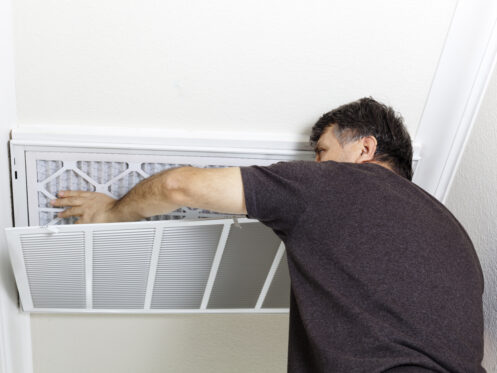
Your home’s air conditioner is a complex system, and one of the most critical components for its health and performance is its air filter. It plays a key role in your AC’s efficiency, your home’s indoor air quality, and the lifespan of your equipment. Regularly changing your AC filter is an essential maintenance task for homeowners.
However, it’s not just about swapping an old filter for a new one. Choosing the right filter for your specific system and household needs is equally important. Regular filter changes keep your system running smoothly, improve your air quality, and save money on energy bills and potential repairs.
Why AC Filters Matter
A clean, appropriate filter is essential for three key reasons: airflow, air quality, and longevity. A clogged filter forces your system’s fan motor to work harder to pull air through, and this restricts airflow. This strain reduces cooling performance, increases energy consumption, and can lead to expensive component failures. A fresh filter keeps your system operating efficiently.
Beyond protecting your equipment, a fresh filter can potentially improve indoor air quality by trapping dust, pollen, pet dander, and other airborne particles. This is especially important for households with allergy sufferers or people with other respiratory sensitivities.
Finally, consistent filter maintenance helps extend the life of your HVAC system. When dirt and debris encounter a clogged or ill-fitting filter, they can accumulate on sensitive internal components like the evaporator coil and fan motor. This buildup can cause the system to work harder and overheat, leading to premature breakdowns. In this case, an inexpensive and minor maintenance task can turn into a major repair bill.
How to Replace Your AC Filter
Replacing your AC filter is a straightforward task that most homeowners can handle on their own. Following these general steps will help you do it correctly and safely.
First, turn off your HVAC system at the thermostat. Then locate and remove the old filter by sliding it out of its housing.
Check the filter size. Look at the cardboard frame of the old filter. The length, width, and depth are almost always printed along the edge.
Select a replacement filter of the same type and size. We offer a convenient online HVAC system filter shop to make this easy.
Install the new filter correctly: The arrow on the frame, which indicates the direction of airflow, must point toward the furnace or air handler. Slide the new filter into the slot, making sure it fits snugly, and make sure any access panels are closed.
Finally, turn the system back on at the thermostat. Your system will now be running with clean, unrestricted airflow.
How to Choose the Right AC Filter
Not all filters are created equal. The best choice for your home depends on your HVAC system’s requirements, your budget, and your goals for indoor air quality.
Common Filter Types
- Fiberglass filters protect equipment from large debris
- Pleated filters capture smaller particles like pollen and dander
- Washable filters are eco-friendly and reusable
- High-efficiency filters offer superior filtration
Understanding MERV Ratings
When you look at pleated or high-efficiency filters, you’ll see a MERV rating. MERV stands for Minimum Efficiency Reporting Value. It’s a scale from 1 to 20 that measures how effectively a filter captures airborne particles of different sizes. A higher MERV rating means the filter can trap smaller particles, providing better air purification.
For most residential systems, a filter with a MERV rating between 8 and 11 offers an excellent balance of air filtration and adequate airflow. This range is effective for trapping common household allergens like pollen, dust mites, and pet dander.
Higher isn’t always better, though. A filter with a very high MERV rating (12 to 14+) can be so dense that it severely restricts airflow, harming your system.
If your HVAC system is not designed to handle this resistance, it can cause as much strain as a dirty filter. Always check your system’s manual or consult a professional to find the maximum MERV rating your system can safely handle.
How Often Should You Change Your AC Filter?
The frequency of filter changes depends on several factors, including the type of filter you use and your home’s specific conditions.
A general guideline for standard 1-inch pleated filters is to replace them every 90 days. However, you should check them monthly and change them sooner if they appear dirty. Homes with pets often require filter changes every 45 to 60 days because pet hair and dander clog filters quickly.
For allergy sufferers, changing the filter every 30 to 45 days can make a difference in indoor air quality by removing more irritants from the air.
Here in Nashua, NH, seasonal factors also play a role. During the spring and early summer, when pollen counts are high, you may need to change your filter more frequently. Similarly, during hot and humid summers when the AC runs constantly, the increased airflow means the filter will capture more debris.
Common AC Filter Mistakes to Avoid
- Wrong size lets unfiltered air bypass the filter
- Restrictive filter strains the fan and reduces efficiency
- Not replacing it often enough leads to clogs and poor performance
- Installing it backward
- Changing filters without ever scheduling professional tune-ups
Schedule AC Maintenance with Joyce Cooling & Heating Inc.
Changing your air filter is a vital step in caring for your air conditioning system. It protects your equipment, improves efficiency, and enhances the quality of the air your family breathes. However, it’s just one part of keeping your system in peak condition.
Professional AC maintenance ensures that all components of your system are cleaned, inspected, and operating correctly. Our experienced technicians at Joyce Cooling & Heating Inc. can perform a comprehensive tune-up to prepare your system for the summer heat.
For expert AC maintenance in Nashua, NH, trust our family-owned, veteran-owned company to keep you cool and comfortable. Contact Joyce Cooling & Heating Inc. today to schedule your service.
Frequently Asked Questions
The easiest way to find the right size is to check your current filter. The dimensions (e.g., 16x25x1) are printed on the cardboard frame. If you can’t find it, you can measure the filter slot itself, but checking the old filter is the most reliable method.
For the majority of homes, a filter with a MERV rating between 8 and 11 provides some reduction of dust without overly restricting airflow. If you have severe allergies or respiratory issues, a MERV 13 filter may be beneficial, but most systems can’t handle it.
Yes, absolutely. A clogged filter makes your HVAC system’s fan motor work much harder to circulate air. This increased effort consumes more electricity, which directly translates to higher energy bills.
In New Hampshire, a good rule of thumb is to check your filter monthly and replace it every one to three months, depending on household needs. You may need to change it more often during high pollen seasons in the spring or during heavy AC use in the summer.
Yes. The wrong size filter allows dirt to get into your system’s sensitive components, which can cause damage over time. Using a filter with too high a MERV rating can strain and potentially burn out the fan motor due to restricted airflow.
